Free Reception Writing Worksheets: Printable Activities for Early Writers
Updated for 2026
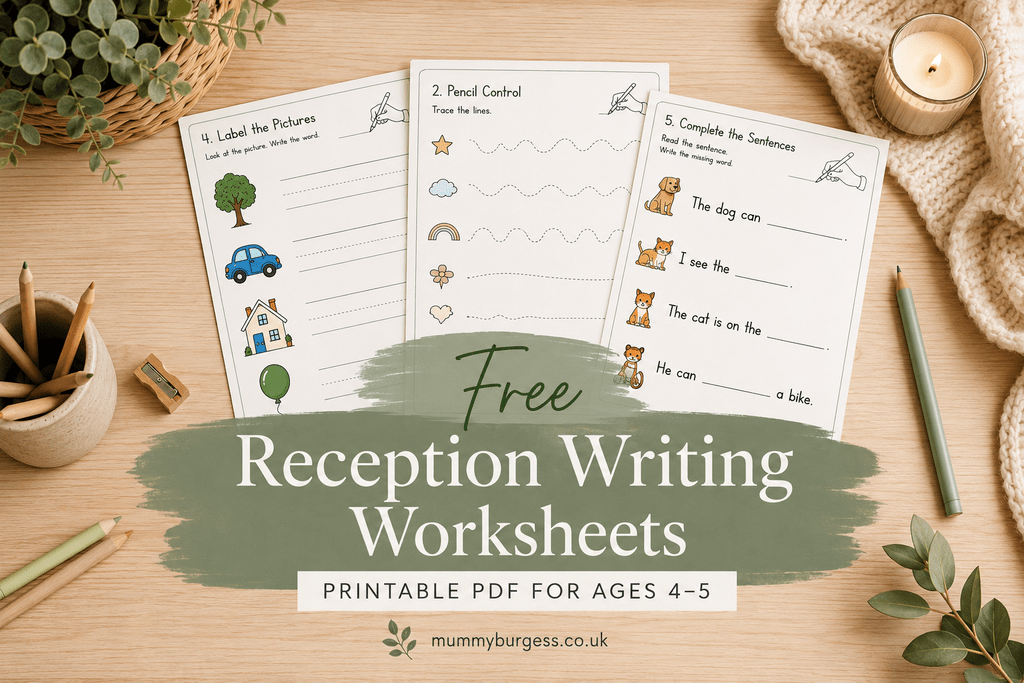
If you’re looking for free Reception writing worksheets to help your child practise their early writing skills, I’ve put together some simple ideas and printable activities to help.
Reception is such an important year for early writing. Children are beginning to bring together lots of different skills: pencil control, letter formation, phonics, spelling and eventually putting their own ideas into simple phrases and sentences.
As a teacher and a parent, I’m a big believer that practice at home doesn’t need to mean sitting down for lengthy “homework” sessions, especially at this age. Short, enjoyable activities can be much more manageable.
Below you’ll find free printable Reception writing worksheets, along with ideas for handwriting practice and simple writing activities you can try at home.
Free Reception Writing Worksheets PDF
The printable pack is designed to give children a variety of ways to practise rather than simply tracing letters over and over again.
It includes activities covering:
- pencil control and pre-writing patterns
- letter formation
- writing simple CVC words
- labelling pictures
- completing simple sentences
- a picture writing prompt
You don’t need to complete the pack in order. Choose an activity that feels appropriate for where your child is currently with their writing.
What Writing Skills Do Children Learn in Reception?
There can be a temptation to compare children’s writing, particularly when they start school and suddenly seem to develop at very different rates.
However, writing involves several different skills working together.
During Reception, children develop their ability to form recognisable letters, use their knowledge of phonics to represent the sounds they hear in words and gradually write simple phrases and sentences that other people can read.
That progression won’t look exactly the same for every child.
Some children may be confidently writing words while still finding letter formation difficult. Others might have beautiful handwriting but need more support hearing and identifying the sounds within words.
The aim of practising at home isn’t to race ahead. It’s simply to give children opportunities to reinforce what they’re learning at school and build confidence.
Reception Handwriting Practice
Handwriting is one of the foundations of early writing.
Before expecting lots of independent writing, children need opportunities to become comfortable controlling a pencil and forming letters.
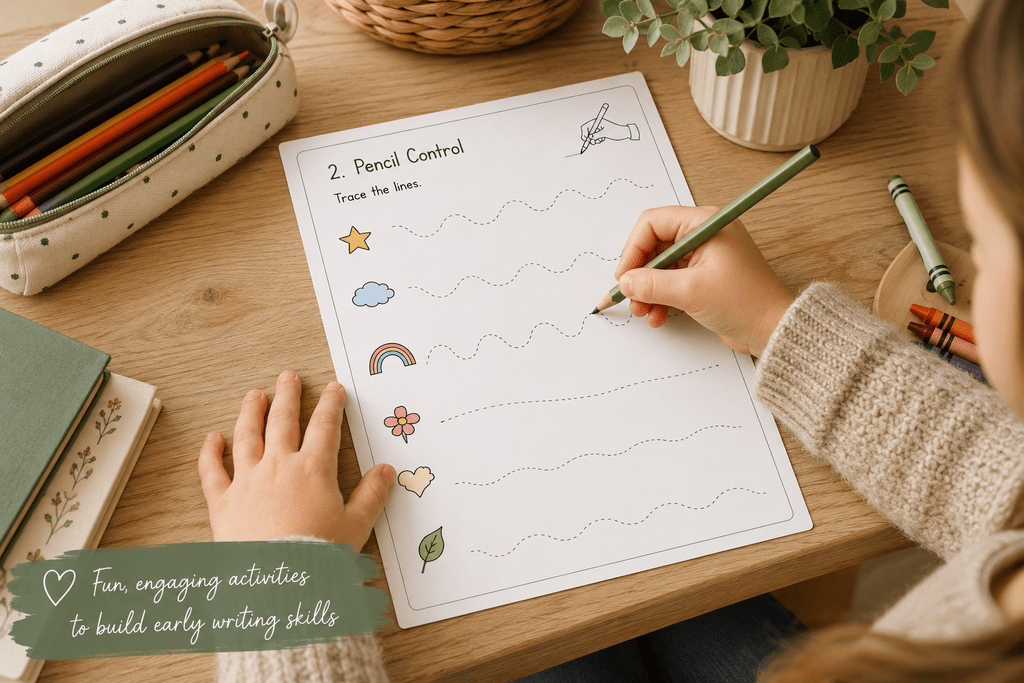
Start with pencil control
If letter formation is still tricky, go back a step and practise movements such as:
- straight lines
- circles
- curves
- zigzags
- waves
- loops
- tracing simple shapes
These kinds of activities can help develop the control needed for handwriting without making everything about forming letters.
You can also build fine motor strength away from worksheets through activities such as playdough, Lego, threading, drawing, painting and cutting.
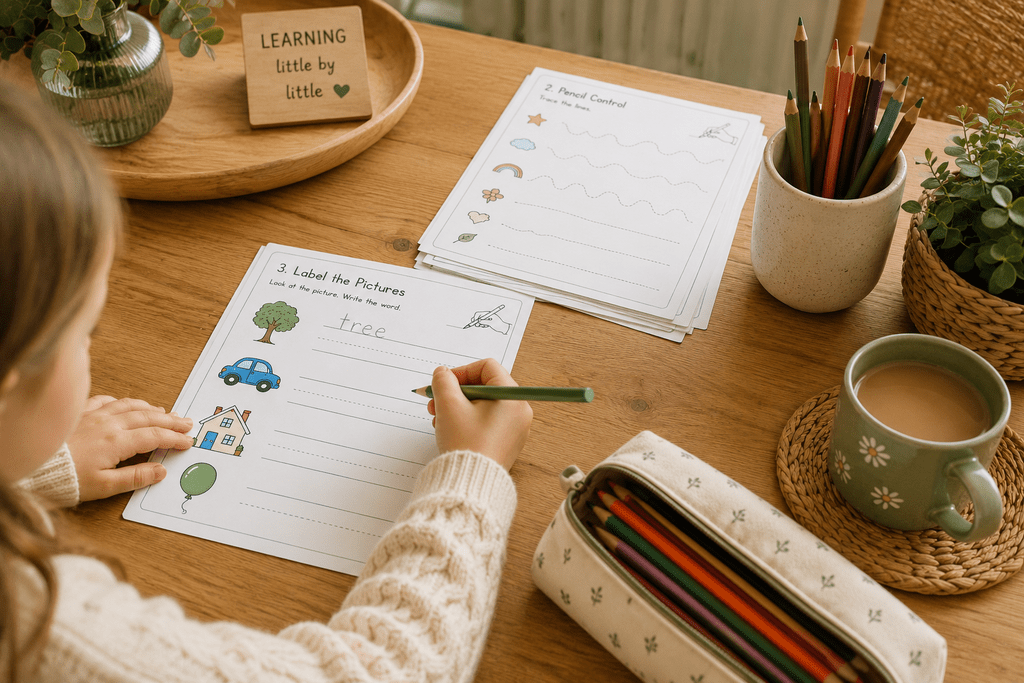
Practising Letter Formation
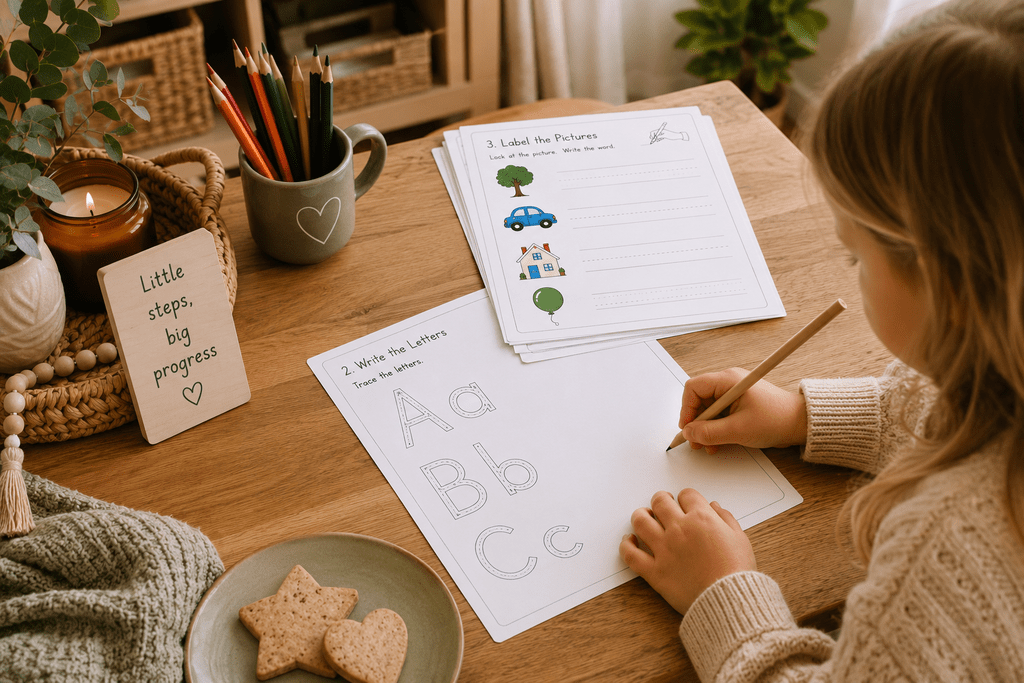
Once children are ready to practise letters, focus on forming them correctly rather than trying to fill an entire page.
A few carefully formed letters are more useful than rushing through several rows.
Try saying the letter sound together as your child writes it. This can help connect the physical action of writing with the phonics they’re learning at school.
It’s also worth checking how your child’s school teaches letter formation. Following the same approach at home can help avoid confusion.
CVC Word Writing Practice
Once your child knows some letter sounds, you can begin practising simple CVC words.
CVC simply means consonant-vowel-consonant, such as:
cat
dog
sun
map
sit
pen
Rather than immediately telling your child which letters to write, encourage them to say the word slowly and listen for the sounds.
For example:
c – a – t
Then see whether they can represent those sounds on paper.
At this stage, the process of hearing sounds and attempting to write them is incredibly valuable.
Picture and Label Writing Activities
One of the easiest ways to make Reception writing practice more meaningful is to use pictures.
Give your child a simple picture and ask them what they can see.
They might label:
cat
tree
sun
hat
dog
You can make this even more engaging by asking your child to draw their own picture first and then add labels.
Suddenly they’re not simply completing a worksheet — they’re writing about something they’ve created themselves.
Simple Reception Sentence Writing
As children become more confident writing words, they can begin putting them together into simple phrases and sentences.
Picture prompts work brilliantly for this.
Show your child a picture and talk about it together before asking them to write anything.
You could ask:
What can you see?
What is happening?
What might happen next?
Children often find writing much easier when they’ve had the chance to say their sentence aloud first.
A picture of a dog running, for example, could lead to:
The dog can run.
Or:
I can see a dog.
The sentence doesn’t need to be complicated. At this stage, a short sentence that a child can attempt successfully is far more useful than expecting a long piece of writing.
Reception Writing Activities That Don’t Feel Like Worksheets
Printable Reception worksheets can be useful, but they certainly aren’t the only way children can practise writing.
Some of our favourite opportunities for early writing are the ones that have an actual purpose.
Try:
- writing a shopping list
- making a birthday card
- labelling a drawing
- writing someone’s name on an envelope
- creating a menu for a pretend café
- writing clues for a treasure hunt
- making signs for toys or bedrooms
- keeping a very simple holiday diary
- writing a list of favourite things
- leaving little notes for family members
These activities help children understand something really important: writing is a way of communicating.
How Long Should Reception Children Practise Writing at Home?
You really don’t need to recreate the school day at home.
For many Reception-aged children, a short five or ten-minute activity is plenty.
If they’re enjoying themselves and want to carry on, fantastic. If they’re becoming tired or frustrated, put it away and come back another day.
Little and often can work beautifully.
Writing practice doesn’t always need to involve a worksheet either. Drawing, painting, cutting, modelling, building and other hands-on activities can all contribute to the physical skills children use when writing.
Should I Correct My Child’s Spelling?
Early writing won’t necessarily look like adult writing — and that’s OK.
Children in reception are learning to hear the sounds within words and work out which letters or groups of letters represent them.
You may therefore see attempts at words that aren’t conventionally spelt correctly but make sense based on the sounds your child can hear.
Rather than focusing on every spelling mistake, encourage them to listen carefully to the word and use the phonics they’ve already learnt.
The goal is to help children become increasingly confident at turning spoken sounds and ideas into writing.
Making Reception Writing Practice Enjoyable
Perhaps the most important thing you can do at home is help your child associate writing with something positive.
Try letting them choose:
- which worksheet they’d like to complete
- what colour pencil they’d like to use
- what they’d like to draw and label
- who they’d like to write a note to
- what topic they’d like their sentence to be about
And don’t underestimate praise.
Rather than simply saying “that’s good”, notice something specific:
“I can see how carefully you formed that letter.”
“You listened really carefully for the sounds in that word.”
“I love the idea you came up with for that sentence.”
It shifts the focus from getting everything perfect to recognising the effort and thinking involved.
More Free Writing Practice Sheets for Kids
If your child is ready for more, take a look at my Free Writing Practice Sheets for Kids: Printable Worksheets for Early Writers.
Those resources cover early handwriting and writing practice for children across preschool, Reception and KS1, so they’re a useful next step if you’d like some additional activities.
Frequently Asked Questions
Are these Reception writing worksheets free?
Yes. The printable Reception writing worksheets on this page are free to download and use at home.
What age are Reception writing worksheets suitable for?
Reception children in England are usually aged four to five. However, children develop writing skills at different rates, so it’s better to choose activities based on what your child is ready for rather than their age alone.
What should a Reception child be able to write?
By the end of Reception, the Early Learning Goal for writing looks at children’s ability to write recognisable letters, represent sounds in words using letters or groups of letters, and write simple phrases and sentences that can be read by others.
Take note: these are end-of-Reception assessment expectations rather than a checklist children need to achieve when they first start school.
How can I help my Reception child with handwriting?
Keep handwriting practice short and regular. Encourage correct letter formation, provide plenty of opportunities for drawing and mark-making, and include activities that develop fine motor skills. It’s also useful to follow the letter-formation approach used by your child’s school.
Are worksheets good for Reception children?
Worksheets can be one useful way to practise a specific skill, but they shouldn’t be the only way young children experience writing. Drawing, play, storytelling, labels, lists, cards and other purposeful writing activities can make early writing much more meaningful.
Download Your Free Reception Writing Worksheets
Ready to practise?
Save the pack, print the pages you need and come back to them whenever your child would benefit from a little extra writing practice.
And remember: Reception writing doesn’t need to be perfect. We’re helping children develop the skills and confidence to put their sounds, words and ideas onto paper — one little step at a time.
K Elizabeth xoxox