Creative Things to Do With Older Kids When Crafts Feel Too Young
There is a particular age, somewhere around ten or eleven, when the craft box stops working. The glitter glue and the googly eyes that used to buy you a whole rainy afternoon get one flat look, and that is the end of that.
It is easy to read this as your child growing out of being creative. Usually it is something narrower. Their taste has raced ahead of their hands, and nothing is more off-putting at that age than making something that looks worse than you pictured it. With September closing in and the evenings about to get shorter and more scheduled, it is worth changing what you offer rather than how often you offer it.
Why does the craft box stop working around eleven?
Younger children make things for the making. Older ones make things for the result, and they judge the result hard. A ten-year-old who draws a horse and can see that it is not quite a horse will often put the pencil down rather than carry on.
That self-criticism is not a reason to give up on the whole idea, but it is a reason to be fussier about what you put in front of them. Telling a child their drawing is lovely when they can see perfectly well that it is not tends to make things worse, not better, and the instinct to hide the thing that came out wrong is not something you can argue anyone out of.
So the job is not to talk them back into crafts. It is to find projects where the gap between what they picture and what they actually produce is small enough to live with.
Choose projects with a finish line
Before you buy anything, it is worth holding a project up against three questions:
- Is there a clear finished state, so they can tell when they are done?
- Will they see progress after twenty minutes, rather than twenty hours?
- If they get it slightly wrong, does it still look deliberate?
Projects that come with a printed guide tend to pass all three, such as embroidery on a stamped pattern, lino printing from a traced design, or the wooden mechanical model kits that are everywhere at the moment. Open-ended “just draw something” fails all three, which is why it so rarely survives the first evening.
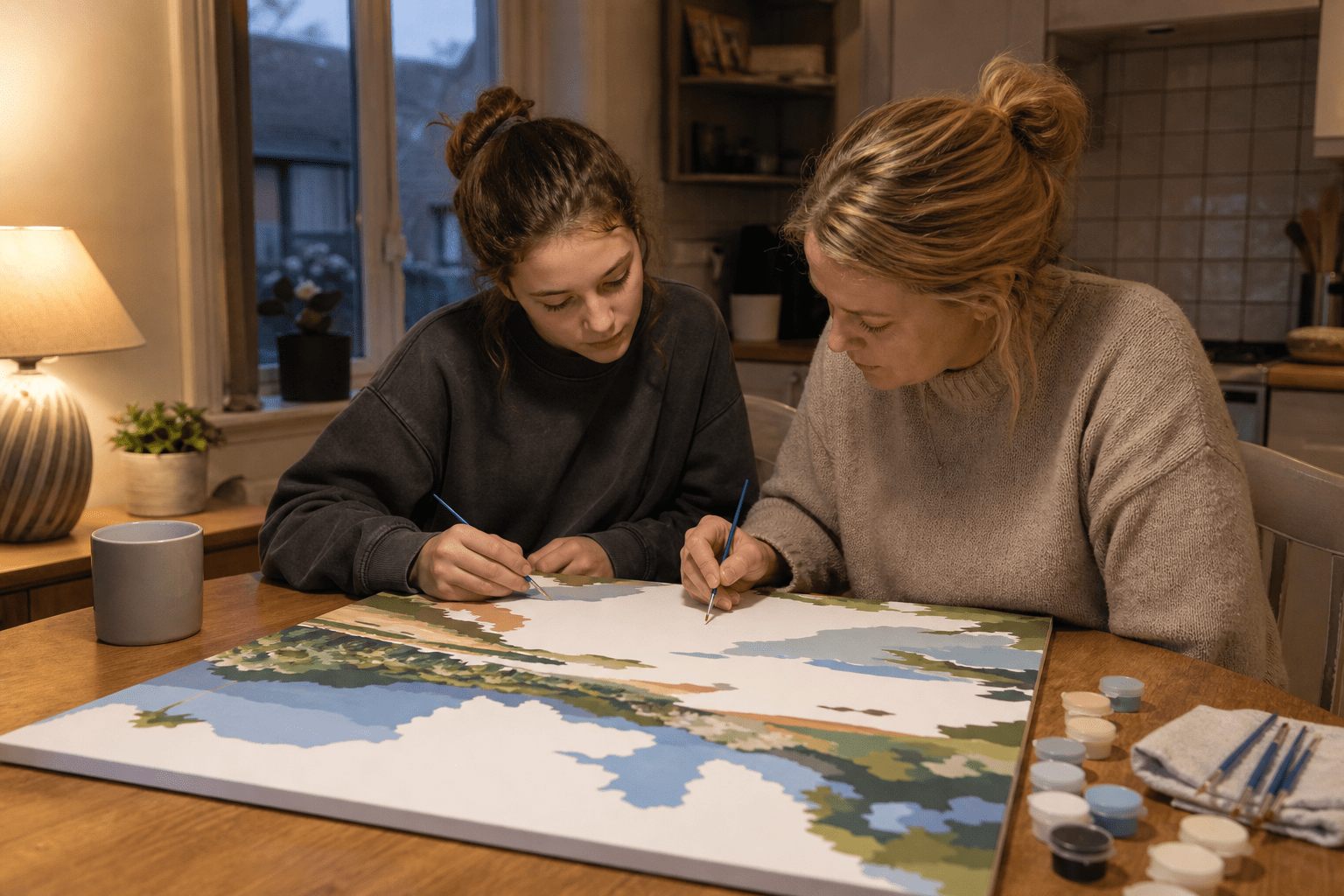
Paint by numbers sits neatly in that group. The outline and the colour map are already on the canvas, so the first half hour is spent painting rather than staring at a blank surface working out where to start. Progress is obvious from across the room, which is exactly the feedback a self-critical eleven-year-old needs.
What a kit like that does not decide for you is the picture on the front of the box, and with this age group that turns out to be the part that matters most.
Let them choose the subject, even if you would not
Ownership is most of the battle. If you pick a tasteful landscape and they wanted the cover art from a band you have never heard of, you have bought yourself a half-finished canvas in the loft.
So let them send the photo. Kits like the ones Davincified makes are built around a picture you upload rather than a stock design, which means what takes shape on the kitchen table can be the dog asleep on the sofa, the beach you went to in July, or the group shot from a festival they went to in the summer. At that point it stops being a craft set and starts being their painting, which is a different thing to walk away from.
Older children will commit to something slightly embarrassing that is theirs long before they will commit to something sensible that is yours. If the finished piece ends up on their bedroom wall rather than in your hallway, that is the project working rather than a compromise. The point was never your decor.
Head off the things that go wrong in week two
A few practical problems turn up reliably with any painting project, and they are worth heading off on day one:
- Dried-out paint. The pots skin over within a day if the lids are left off, so make closing them part of packing up.
- Dark colours too early. A dark shade brushed over a light one that is still wet is very hard to rescue, so work light to dark and let each area dry.
- The boring bits. Nobody wants to do the sky. Agree who is taking the large flat areas before either of you has started the interesting parts.
It is also worth buying two or three extra brushes in a couple of sizes. Kits are supplied with the basics, and the fine detail at the end is far less frustrating with a proper small brush from an art shop. A modest set of Winsor & Newton synthetic brushes will outlast several projects.
Then set the whole thing up somewhere it can stay out. Packing everything away after every session is the single most common reason a project quietly dies. Older children in particular will not dig a box out of a cupboard for twenty spare minutes, but they will sit down at something already open on the table.
Sit beside them, not opposite them
Anyone who has tried to have a proper conversation with a twelve-year-old across a table knows how that goes. Side by side, with both pairs of hands busy, is a completely different experience. Car journeys work for the same reason, and so does washing up together.
There is decent evidence that the making itself does some of this work too. The Mental Health Foundation notes that getting involved with the arts “can help to protect against a range of mental health conditions, help manage mental ill-health and support recovery”. It also makes the point that art helps people express themselves without having to use words. For a child who has recently stopped telling you about their day, that second part matters more than whatever ends up on the canvas.
A shared project buys you an hour of that a few times a week without anyone having to announce that it is time to talk. You do not need to be any good at it, either. Being visibly average at something in front of your child is quietly useful, because it shows them that grown-ups carry on with things they are not brilliant at.
Find the slot in the week
Term time brings a rhythm back, and rhythm is what a creative habit actually needs. Pick one repeating slot instead of promising yourselves a big Saturday session that never quite happens. It helps to hang the slot off something that already occurs, such as the half hour after tea on a club night, or Sunday evening while the week is being got ready for.
The NHS’s Every Mind Matters advice puts the principle simply, that “from enjoying your favourite hobby, learning something new or simply taking time to relax, it’s important to do things that make you happy”. Short and regular beats long and occasional, especially once homework, clubs and everything else are competing for the same evenings.
Keep the bar low on the weeks it does not happen. A project picked up twice one week and once the next is still a project, and a canvas that takes two months is not a failed canvas.
Creative time with older children looks different from creative time with a four-year-old, and it should. The craft box was never really the point. What worked about it was the sitting down together, and that has no age limit. It just needs different contents: something with a finish line, a subject they chose themselves, and a corner of the table where it is allowed to live until it is done. Creativity doesn’t have to mean sitting at the kitchen table with a pile of craft supplies. Getting out and looking at art can be just as inspiring, particularly as children get older. Galleries are an obvious choice, but even simply exploring street art in London can spark conversations about different styles, techniques and the messages artists are trying to communicate.
K Elizabeth xoxox
*Collaborative Post